
History
History of Allotments in England.
Allotments can be traced back to the 11th and 12th centuries, when manors or villages were surrounded by large fields that were split into long narrow sections, which allowed families to grow crops. The sections were one furlong (around 200m) by one chain (around 20m). Each villager had several strips, which were widely scattered so the land was distributed fairly; and crops rotated – barley in Year 1, wheat in Year 2 and laying fallow in Year 3. In addition to these fields, there was common land for livestock to graze and woodland for hunting.
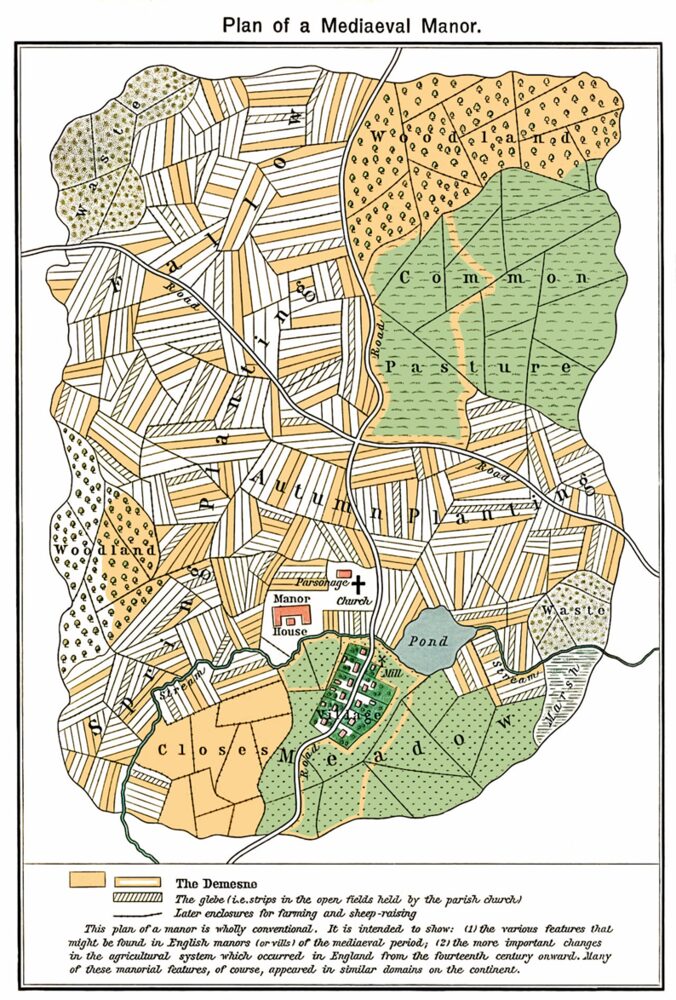
By the 16th century, England’s population grew from 1.5-2 million in 12th century to 5.5-6million and together with: introduction of new crops, such as turnip, swede and potatoes; an increase in large animals, such as horses and cows; an increase in manure from large animals; and an increase in demand for food for the large animals, all placed a greater demand for land and made the ‘open system’ difficult to continue. By the late 1500s these large fields and common land was divided up and enclosed by hedges, which not only denied access to people who had previously been able to grow and graze freely but changed the English landscape and introduced the landowner.
Between 1670 to 1870, 3500 Acts of Parliament were passed to enclose 7 million acres of common fields and lands – with only 0.5% of land set aside for the poor. The counties most affected by enclosures were Sussex, Hampshire, Suffolk, Norfolk, Berkshire, Wiltshire, Oxfordshire, Buckinghamshire, Northamptonshire, Devon, Dorset, Gloucestershire, Bedfordshire, Cambridgeshire, and Kent. Until 1919 allotments were only available for the landless or labouring poor and there were various movements to try and provide land for the poor because it would reduce crime and immorality, reduce the number of labourers sent to prison or Australia, reduce the amount spent on Poor Relief, and just as industrialisation was taking a hold, stop the migration of farm labourers to industrial towns.
The term ‘allotments’ was first used in the General Enclosure Act of 1845. Primarily, this Act allowed landowners set up commissioners, usually other landowners, to enclose land without Parliamentary approval, but it also required landowners to ‘allot’ a quarter of an acre of land, a field garden, for the landless poor to farm. A quarter of an acre was deemed enough land to feed a family of four but not tire or occupy too much time of the labouring poor who were needed to work for the landowners. However, very few landowners made provisions for the for the landless poor and they mainly were confined to rural areas. It was not until the late 19th century that parcels of land in urban areas were used as allotments, with Birmingham, Coventry, Nottingham and Sheffield leading the way – all situated in the black country with high density housing and with little to no garden. Southampton was also at the forefront of providing allotments, presumably to supply food for its naval base, the biggest in England at the time.
Rapid industrialisation and population growth (by the 19th century England’s population was 16.5 -30million) led to an increase in poverty, which also increased the demand for allotments and legislation for allotments. First was the Allotment Extension Act (1882) which required all trustees holding charity land, to set aside part of that land for allotments. This was followed by the Allotment Extension (1885) which stated that allotments must be let at the same rate as surrounding farmland and more importantly, the Allotment Extension Act (1887) – was the first attempt at legislating that local authorities, or Sanitary Districts were to provide allotments for the landless poor and not landowners or the clergy. The Act also enabled Sanitary Districts to compulsory purchase land to provide allotments.
The Local Government Act (1894) introduced County Councils to oversee Sanitary Districts and they were required to have an Allotment Committee which was responsible for holding inquiries if a Sanitary District failed to provide allotments. In 1899, the Board of Agriculture, which later became the Ministry of Agriculture and Fisheries, was introduced by Parliament, and inherited the powers of the Enclosure Commissioners.
Throughout the 20th century the Allotment Acts focused on providing land for allotments and protecting the tenants’ rights and new legislation was added or altered to the existing legislation to reflect the changing roles of allotments. All Allotment Acts are still in force today.
The Smallholdings and Allotments Act (1907) consolidated all the previous acts and the responsibility of providing allotments to the landless poor fell to the County Councils and their local authorities. The Board of Agriculture ensured that County Councils were providing allotments. The Smallholdings and Allotments Act (1908) standardised plot size for the first time – 10 poles (or rods), approximately 250m2. It also permitted county councils/local authorities to charge rents: “council must recover their costs and not run a loss-making allotment” with a 40-day payment period. It implemented a Notice to Quit to evict plotholders; allowed local authorities may make improvements to allotment land, such as drainage and paths; and allows local authorities to sell land if they are of the “opinion is not needed for the purpose of allotments”. This Act is the first to introduce compensation for plotholders who were required to leave the site.
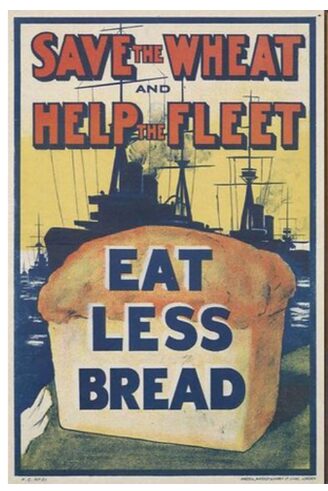
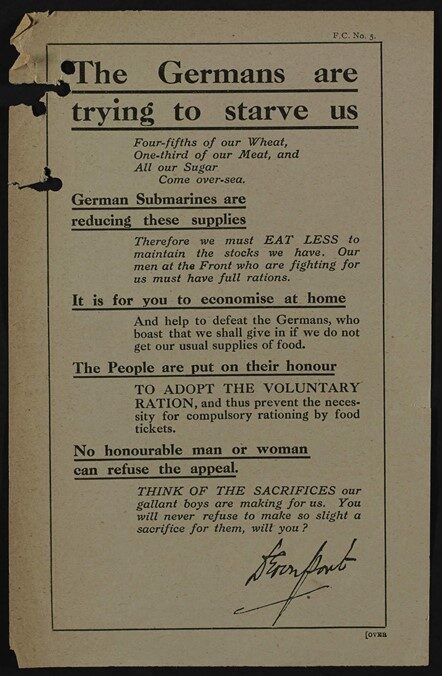
The First World War further fuelled the growth of allotments, and the number of plots grew from 674,000 in 1914 to 1.5 million in 1918, the largest number of plots. World War 1 took soldiers and horses away from farming which reduced the amount of food being produced and a large proportion of that food was exported to feed the soldiers on the Western Front. Parliament introduced British Summer Time Act in 1916, to reduce energy and increase war production, particularly in agriculture. The UK had the strongest and biggest naval fleet and food imports was not greatly affected until the Russian Revolution when the new Bolshevik government of Soviet Russia negotiated the Treaty of Brest-Litosvsk with Germany in March 1918. In return for Russia withdrawing from the war, they conceded Poland, Belarus, Ukraine, and Finland to the Germans – all agricultural and mining territories that exported food and coal to the UK. In addition to reduction of food imports from Russia, was Germany’s deployment of U-boats. By 1917, Germany was using their U-boats to attack merchant ships, rather warships, and consequently starve the UK into submission. In 1917, 46,000 tons of meat and 85,000 tons of sugar were lost at sea and 1500 merchant ships were sunk in the autumn alone,
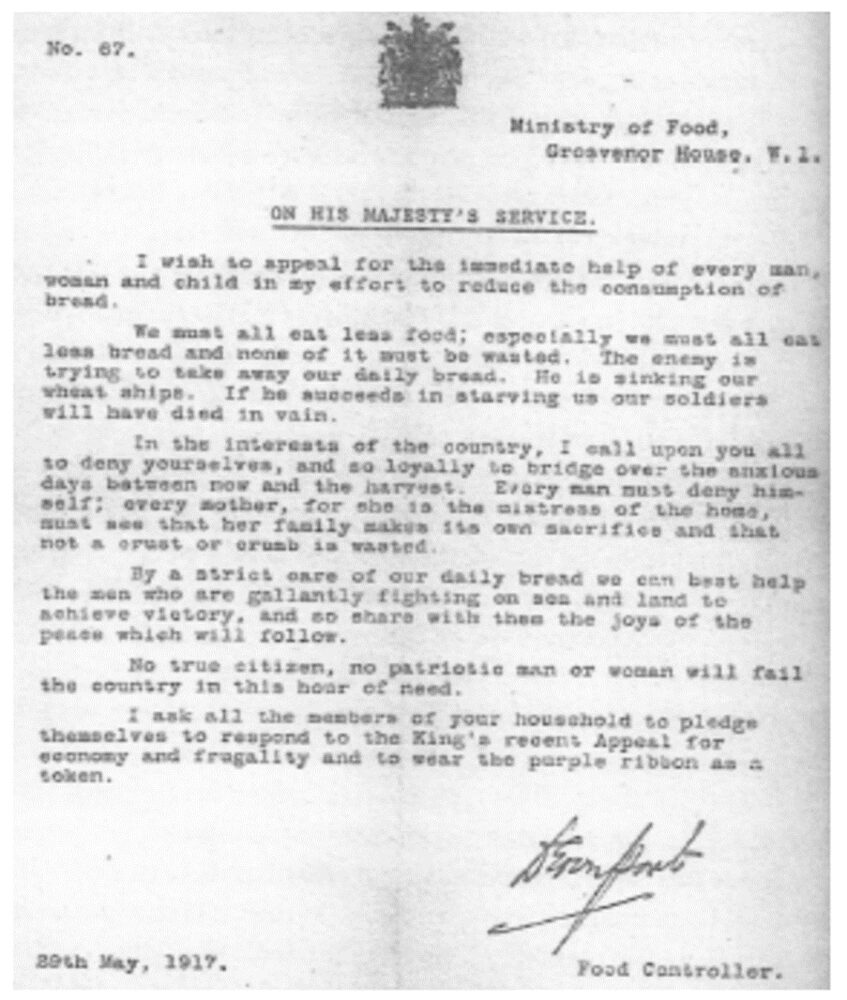

and so fears that the UK’s food stocks could run out in weeks intensified. As food prices soared, followed by panic buying and hoarding the Government put price controls on staple food and eventually introduced rationing in 1918 (ended in 1920). Growing your own food became essential for the people and the demand for allotments increased. Local authorities turned any derelict land into allotments and set up model plots to teach new gardeners how to grow their own vegetables and fruit. A major source of land was land owned by railway companies and their plots were allotted to the railway workers, which is why many allotments are located by railway lines today.
However, many of the allotments were temporary allotment sites and were returned to their original use at the end of WW1. Also, the demand for housing (Homes for Heroes) and recreational grounds also reduced the number of allotments available, especially in urban areas. In 1919 the Land Settlement Facilities Act was introduced to help returning servicemen after World War 1 and made allotments available to all and not just the landless poor and labouring poor. This Act also enabled Allotment Committees to appropriate land held for other purposes, ie railway sidings and parks.
Throughout the 1920’s three more Allotment Acts were passed. The Allotment Act (1922) defined and allotment garden as: “not exceeding 40 poles {a quarter of an acre}…mainly cultivated by the occupier for the production of vegetables and fruit crops for consumption by himself or his family” and strengthened tenure for tenants – landlords issuing Notice to Quit must now give at least six months’ notice to their tenants. The Act also introduced compensation for tenants if they were forced to quit their allotment, based on the value of their crops; and required landlords to charge a “full and fair rent” for plots.
The Allotment Act (1925) introduced ‘Statutory Allotments’ – land purchased or appropriated by local authorities for the use of allotments and cannot be sold or reused without Ministerial consent. Also, this Act stipulated that Local Authorities must consider including allotments in any town plans, which was repealed in 1972.
By 1939, the number of plots had reduced to 814,917 and the UK was importing 55 million tonnes of food per year – 70% of the food consumed. When World War 2 was declared in September 1939, the Government launched the Grow More Food campaign or better known as the Dig for Victory campaign (coined by a journalist at the Evening Standard – Michael Foot) in October 1939 which used patriotism to motivate people to grow their own food and become self-sufficient, which, more importantly freed up the ports for the war effort. Posters were put up in local shops, public buildings, and village halls. By January 1940, sugar, meat, fats, bacon, and cheese were rationed. Fruit and vegetables were never rationed, just in short supply, and so the demand for allotments increased. However, due to the house building, the introduction of Green Belt and implementation of recreational grounds since World War 1, available land for allotments was in short supply and so the government encouraged people to grow fruit and vegetables in their own gardens. The Government reintroduced demonstration plots in parks to teach people how to grow their own vegetables and grow them efficiently to produce maximum produce and produce vegetables and fruit all year round. Together with the Ministry of Information, films were produced to encourage more vegetable growing and instructional leaflets were distributed on all aspects of fruit and vegetable cultivation in 1943. By 1943, the number of plots increased to 1.4 million and were producing over a million tonnes of food. At the end of World War 2, 500,000 plots disappeared as the allotment land was reverted to its original use – housing, schools, and recreation grounds and parks.
In 1950 the final Allotment Act was introduced. It required 12 months’ notice for a landlord to issue a Notice to Quit, and stipulated it must expire during the winter months. It also specified the amount of compensation payable to a tenant according to the season their tenancy terminates. Also, any tenant who allowed their plot to deteriorate through neglect were now liable to pay compensations for dilapidations. The landowner can charge “as a tenant may reasonably be expected to pay for the land” and most importantly allotment gardens allowed chickens and rabbits to be kept on allotments, subject to bye-laws.
Rationing ended in 1954 and marked the decline for allotments. Introduction of supermarkets, housebuilding, vandalism and neglect at allotments further contributed to the decline of allotments. Additional factors such as the Beeching line closures which closed railway lines and their allotments, cheap food imports and the explosion of leisure and recreational facilities also made allotments unappealing. The recession between 1973-75 and the Good Life which ran from 1975 to 1978 reversed the decline for allotments, but by the 1978 only 470,000 plots were still in use.
There was another resurgence for allotments in the early 1990’s, again initiated by the global recession but also by concerns about chemical pollution and contamination of shop bought fruit and vegetables. However, by 1996 around 297,000 plots are left in the England and Wales and because of the escalating cost of land, many local authorities sold off allotments for high prices to housing developers. In the 2000’s concerns about genetically modified food initiated another peak in demand for allotments which was also coupled with another global recession in 2008. This demand continued because of people’s concern about food air miles and new house building having little to not outdoor space. However, the demand exploded during the COVID lockdown, where many allotments were closing their waiting lists to cope.
History of Byng Road Allotments
In 1937, the Physical Training and Recreation Act was introduced by Parliament and this little-known Act has had the greatest impact on the history of Byng Road Allotments. This Act was in response to a disappointing medal count in the 1936 Summer Olympics, keeping the unemployed active during the Depression and as World War 2 loomed, to improve the health and fitness of the population. Very simply put, the Act established the National Fitness Council to provide funding for sporting organisations, grants to train and provide instructors, and develop facilities for physical training and education. After World War 2, the Board of Education took over from the National Fitness Council. Boy Scouts, swimming centres (lidos), camp sites, community centres and playing fields and sports clubs all boomed at this time.
From 1894 to 1964, Barnet Urban District Council (UDC) came under Hertfordshire County Council, which was established under the Local Government Act (1888). From 1965 onwards, Barnet became a London Borough. While UDC and County Council shared local responsibilities like the provision of allotments and housing; education and roads were the sole responsibility of County Councils.
In 1937, Hertfordshire County Council bought two fields from Barnet Urban District Council (UDC), for £5738 – Fields #14 with 9.084 acres and 15 with 9.497 acres “as Playing Fields for children attending the Barnet Elementary Schools” (Parks and Open Spaces Committee, Tuesday 31 August 1937). These two fields were known as Byng Road Land and is where Christchurch School (Field 14) and Noah’s Ark/Environment Centre (Field 15) are currently located. Once the loans were paid off, Barnet UDC was left with £508 that was to be used for capital purposes only and so it was used to purchase office machinery for the accountant’s department (Finance and Establishment Committee, Tuesday 7 February 1939).
Before this purchase these fields were used as grazing fields for cattle, but in May 1937, the Barnet UDC’s Local Education Sub Committee pointed out “that the grazing of certain cattle on this land deprived children of West Barnet of the opportunity of playing thereon” (Parks and Open Spaces Committee, Tuesday 25 May 1937). By June 1937, Mr Roberts from Homestead Farm in Galley Lane, who was renting both fields and Barnet UDC agreed that he would enclose his cattle in Field 15, so Field 14 could “accommodate the school children thereon for recreational purposes” (Parks and Open Spaces Committee Tuesday 29 June 1937). Also, Mr Roberts agreed to plant 1175 feet (around 358 metres) of hedging to cattle proof the field, and in return Barnet UDC agreed to compensate him £5, equivalent to £280 today, (https://www.bankofengland.co.uk/monetary-policy/inflation/inflation-calculator) for the loss of grass. Field 14 was mowed with advisement of the Headmaster of Byng Road School (now Foulds School) and was now available for elementary school children, with the costs passed onto Hertfordshire County Council.
In October 1939, the Ministry of Agriculture and Fisheries issued the Cultivation of Lands (Allotments) Order “urging Local Authorities to exercise their powers thereunder, on behalf of the Minister, with the object of increasing food supplies by the provision of land for cultivation”. Even though this Order and the Dig for Victory Campaign are now used interchangeably, back in 1939, the Dig for Victory campaign was the propaganda encouraging the home population to produce more food and this Order allowed Local Authorities to appropriate land for food production, i.e. set up allotments. Barnet UDC, after “careful consideration to this matter ….. do not deem it necessary to utilise these powers in respect of any land not under the Council’s ownership, there being sufficient land already in possession of the Council to deal with the present requirements.” (Allotments Committee, Tuesday 3 October 1939). In addition to Bells Hill Allotments, which already existed:
“About 30 applicants for war time allotments were received, an your committee were of the opinion that the following lands might be put into cultivation to the extent of the approximate areas mentioned: – (a) Sewerage Fam and near Leeside Works, south of the Council Cottages in May Lane – four acres (b) Brookside Walk from LNER westwards to Barnet Lane – five acres (c) Chesterfield Road, five acres (d) Brookside Walk at the rear of Longland Drive – five acres.”
“In addition, it was felt that an application should be made to the Hertfordshire County Council for a portion of the Byng Road Land recently purchased by that Authority. The forgoing proposals would provide accommodation for about 400 plots of 10 poles each.” (Allotments Committee Tuesday 3 October 1939).
The Byng Road Allotments was one of the first wartime allotments established and the only one of the original wartime allotments to still exist today. Anyone could apply for a plot, providing they were not a tenant at an existing allotment, at a rate of 9d per pole, around £1.50 – £2.12 today, https://www.bankofengland.co.uk/monetary-policy/inflation/inflation-calculator. Also, according to Peter and Angela Morris, one of the first tenants at Byng Road Allotments was Edward and Hilary Eyre and they state there was no water supply, sheds were not allowed, and only vegetables were permitted. However, one tenant circumvented this rule by planting flowers in the centre of their plot and vegetables around them. Until 19 , you needed permission from the Allotments Committee to plant fruit trees and the requests were usually denied because they caused a nuisance to nearby plots with their shade.
It would not be until March 1940 that Hertfordshire County Council and Barnet UDC finally agree on Terms and Conditions. While Hertfordshire County Council supported the use of this land for allotments, the impasse was due to who paid for the ploughing, levelling and reseeding of the land at the end of the allotments’ tenancy, with Barnet UDC finally accepting this cost (Council Meeting, Tuesday 26 March 1940). By December 1939, 28 ten pole plots were pegged out at Byng Road Land Allotments and 19 had already been let (Allotments Committee, Thursday 28 December 1939). At this same meeting the Allotments Committee arranged for a speaker from the Hertfordshire Institute of Agriculture to speak at the next War Time Allotments Holders meeting at Barnet Cinema Café on Thursday 11 January 1940 at 7.30pm, to discuss the cultivation, formation of an Allotment Holders’ Association and the cooperative purchase of seed potatoes.
The Ministry of Agriculture and Fisheries issued another Memorandum on 10 September 1941 urging for more allotments under the Cultivation of Lands (Allotments) Order, and the following land was appropriated: Hadley Manor Estate (10 plots), Valley View (20-40 plots), Chesterfield Road (12 Plots), Barnet Barracks (10 Plots) and the northern part of Barnet Playing Fields (10 Plots). Interestingly, this memorandum “emphasized the need for women and adolescents to undertake the cultivation of allotments (Allotments Committee, Tuesday 30 September 1941).
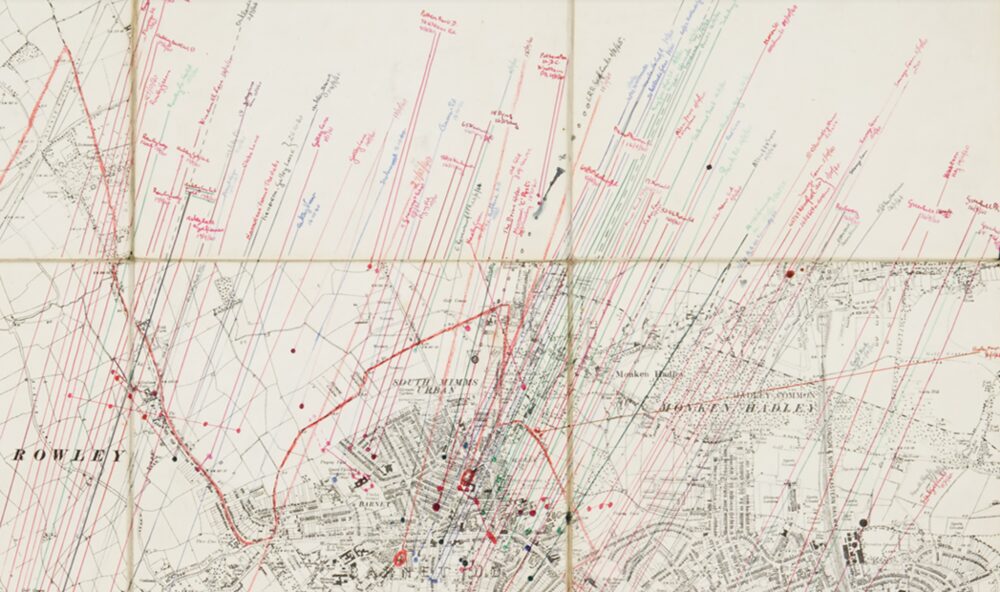
There was a high explosive bomb dropped on Byng Road Playing Fields on 13 October 1940, which may account for the stoney plots by our west fence; and two high explosive bombs dropped on the allotment site which may explain why west corner of Field 15 was never cultivated; as well as 5, possibly 6 high explosive bombs dropped on Queen Elizabeth Boys School on 11 January 1941 Figure 1: Barnet Urban District Bomb Map. Compiled on 1 March 1945.
By 1943, there were 17 vacant plots at Byng Road Allotments and it “was agreed that publicity should be given as to these vacant plots, and also that a list be published on the Notice Board at the Demonstration Allotment at Old Court House Grounds.” (Allotments Committee. 13 July 1943). In 1944, the vacant plots had increased to 29. Also, the Allotments Committee have £50 available for improvements and consideration was given to fencing of certain war-time allotments, with Byng Road Allotments being one (Allotments Committee, Thursday 25 May 1944).
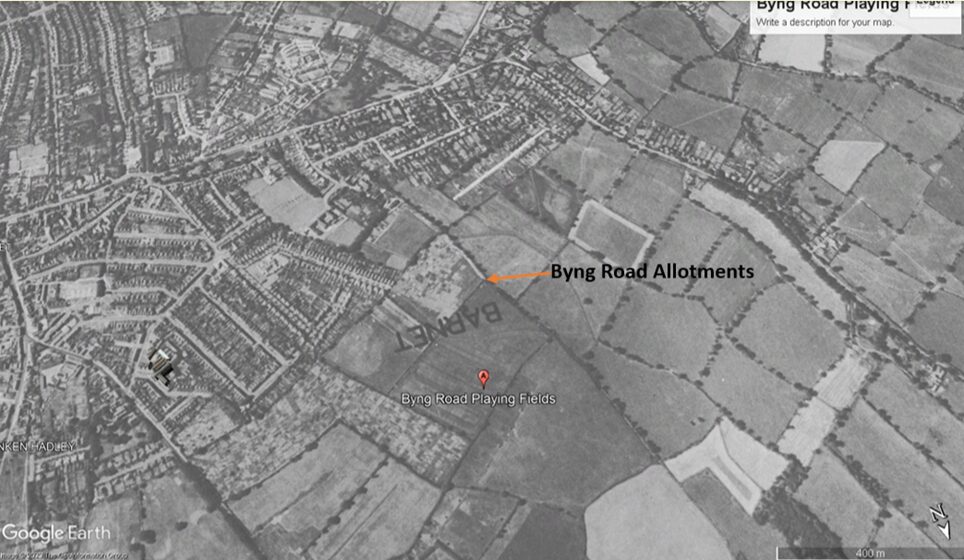
By the end of World War 2, Byng Road Allotments had 35 vacancies (Finance and Establishment Committee, Tuesday 6 November 1945) and unlike World War 1, where many temporary allotment sites returned to their original use at the end of the war, the Ministry of Agriculture and Fisheries urged Local Authorities to produce more food and retain their war-time allotments and “permission to give up war-time allotment sites where required, would only be forthcoming from the Ministry where land is urgently needed for priority housing purposes” (Allotment Committee, Tuesday 26 February 1946). Rationing did not end until 1954, the Dig for Plenty (Dig for Victory ended with World War 2) campaign was in full swing and a Circular 2319 from the Ministry of Agriculture and Fisheries was issued, again demanding more food production (Allotments Committee, Monday 27 January 1947).
In May 1947, the Allotments Committee agree to a water supply at Byng Road Allotments and in January 1948, the Allotments Committee add an additional charge to cover the water usage – “one shilling per annum for the tenants at Byng Road Allotments”. The water tap is damaged, together with cultivated plots by straying cattle from the neighbouring fields and the local farmer is held liable for the damaged taps and hedges (Allotments Committee, Monday 29 September 1947). There is also a complaint about a heavy motor lorry parked within Byng Road Allotments by Mr AT Taylor of 44 Byng Road, and rubbish dumped at Byng Road Allotments (Allotments Committee, Monday 5 May 1947).
Changes for Byng Road Allotments
In June 1947, that Barnet UDC makes use of the Allotments Act (1925) and uses its powers to appropriate land for permanent allotments and designates Great Bushey Drive, Fairfield Way. Grange Estate and Byng Road Allotments as statutory Allotments. Hertfordshire County Council, who own Field 15, where Byng Road Allotments is located, “are to be approached with view to the retention of this land for allotment purposes, if not on a permanent basis than on a long-term lease” (Allotments Committee, Monday 30 June 1947).
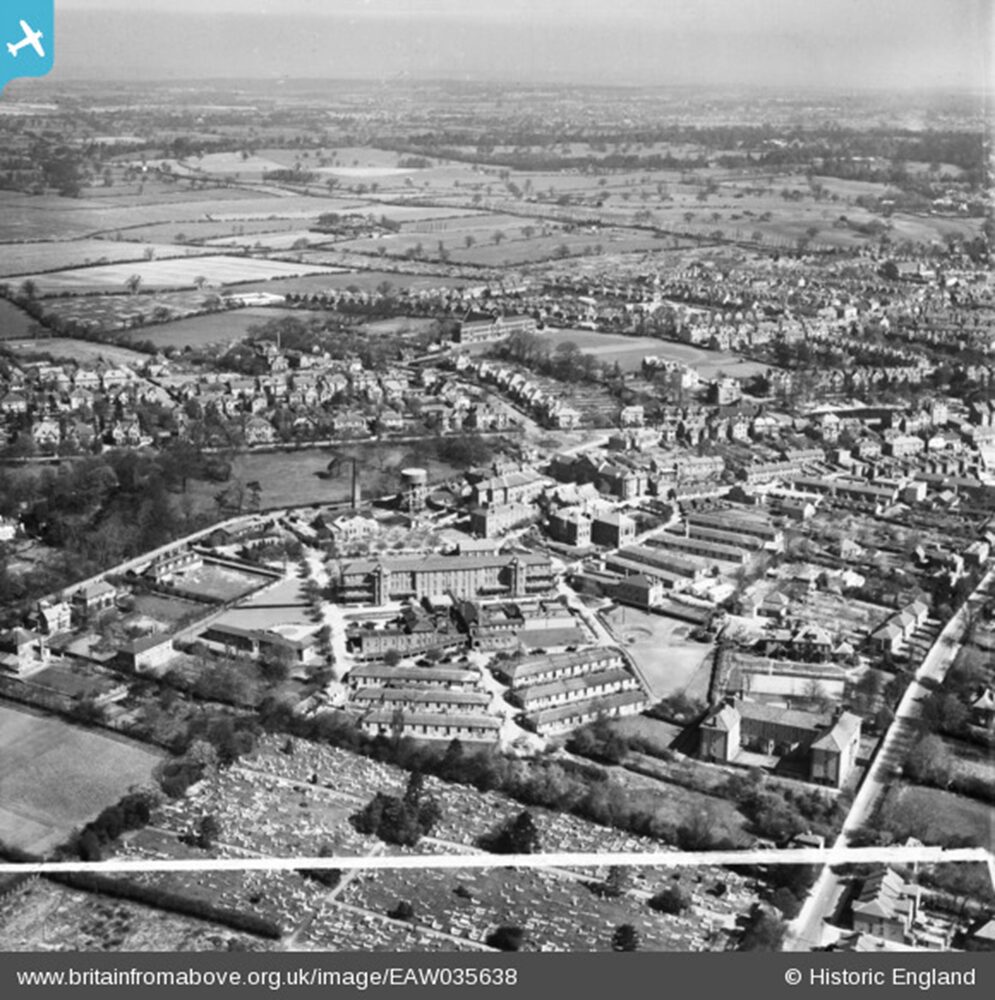
Instead, Hertfordshire County Council ask for a portion of Field 15 for “ the erection of [school] huts for accommodating the extra number of children now attending schools consequent upon the raising of the school-leaving age” (Allotments Committee, Monday 27 October 1947). The Education Act of 1944 increased the school leaving age to 15 years old and separated elementary schools into Primary Schools for children between 5 to 11 years old and secondary schools for children between 11 to 15 years old. Hertfordshire County Council’s proposal would affect 35 plots, of which 21 are under cultivation and so Barnet UDC asks Hertfordshire County Council to reconsider its decision and suggests using the field immediately west (Byng Road Playing Fields) or on the part of this field that is not under cultivation. In December 1947, Hertfordshire County Council refuse these suggestions from Barnet UDC, and it is not until January 1948 that a compromise is finally reached – the school huts are be placed 10 feet from the Council’s access path and so only seven cultivated plots would be affected and parts of two other plots. Barnet UDC peg out another 35 plots on this field as there is now a waiting list, and to compensate the 9 tenants who made way for the school huts. By the end of 1948 a new entrance for the allotments is installed further down the access track and by August 1948, the school huts were underway. However, Byng Road Allotments lose their water supply, as it is now within the school boundary. While Hertfordshire County Council allow Byng Road Allotments to share the water supply with the new school, there is no access to the water supply during weekends and summer months, and so it was decided that Byng Road Allotments should have their own water supply at a cost of £23. There then was a six month delay for steel water pipes (Allotments Committee, Monday 25 April 1949) and water supply to Byng Road Allotments would not be sorted until 1950. Also, 1949 brought scandal to the Byng Road Allotments, with the tenant at Plot 84 allowing it to be overgrown with weeds and a Notice to Quit was issued; and Plot 61 left the allotments without paying the additional water charge and the amount was written off as irrecoverable.
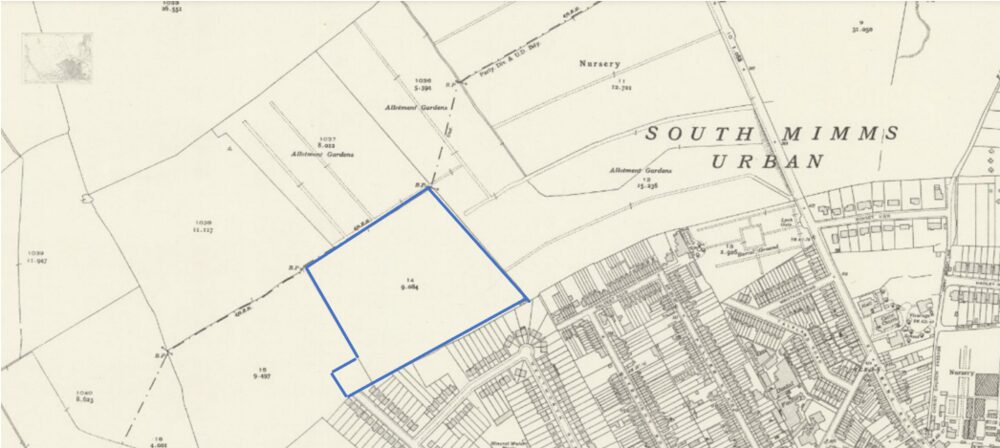
1950, is a pivotal year, not only for Byng Road Allotments but also for the entire area, and the decisions will shape the area as we know them today. Firstly, a petition from residents of Old Fold View “urging the provision of adequate footpath facilities there from to the Byng Road School area” (Council Meeting, Tuesday 14 March 1950) and a letter from Mr GM Hatt requesting a footpath to Byng Road Allotments from Old Fold View (Allotments Committee, 28 August 1951). After eleven Council Committee Meetings this path was eventually built in 1952. The path that was created is still used today and it is between Queen Elizabeth Boys School and Noah’s Ark Children’s Hospice.
More importantly, was another petition from Mr WJ Stephens of 3 Byng Road with 557 signatories delivered at a Council Meeting on Tuesday 28 March 1950, objecting to Hertfordshire County Council fencing the new school huts and the adjacent Playing Fields. It prevented residents’ access to West Barnet Allotments, (allotments belonging to Potters Bar UDC, where Barnet Elizabethans Rugby Football Club are now located) Byng Road Allotments as well as the use of the playing field which has been enclosed as playing fields for the new school.
While Hertfordshire County Council cease the fence building, it forces the Barnet UDC’s Allotments Committee to seek clarification on the future of Byng Road Allotments, as its request to appropriate it as a permanent allotment was still in negotiation, since 1947. Under the Physical Training and Recreation Act (1937), schools were required to have playing fields, and so Hertfordshire County Council suggest enclosing Field 15 which would not impede anyone’s access to West Barnet or Byng Road Allotments and:
“concerning the 88 allotment plots at Byng Road, and enquiring as to the prospects of moving the allotment holders thereat to a proposed new site on adjoining land owned by this authority. The County Council propose after September next to use the land in their ownership for the purpose for which it was acquired for, ie playing fields for schools in the district”. (Allotments Committee, Tuesday 27 February 1951)
Barnet UDC agree to this request, but because the Allotment Act (1950) had just been introduced, the tenants could not be moved without 12 months’ notice, ending in the winter months, and so Lady Day (25 March) 1952 was the earliest Hertfordshire County Council could enclose Field 15 for Byng Road School and its playing fields. The Allotments Committee also negotiate that the new location for Byng Road Allotments also become a Statutory allotment:
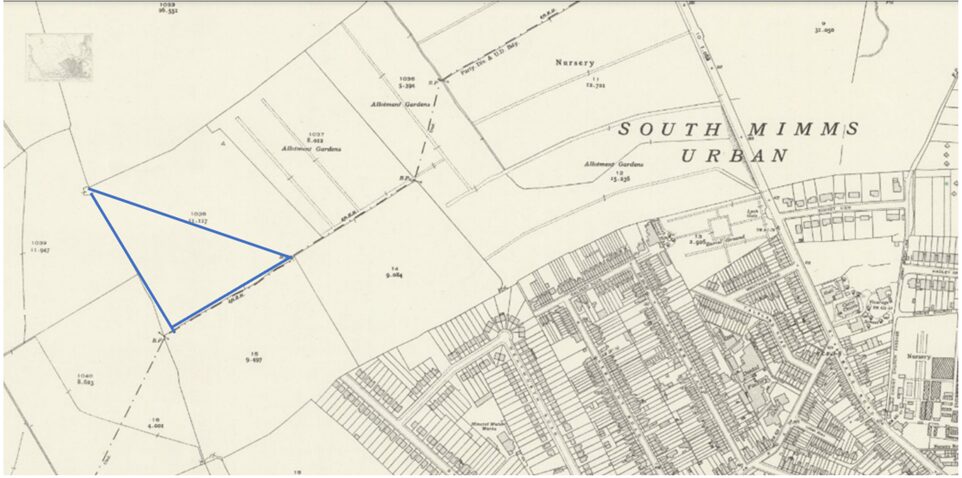
“..application be made to the Ministry of Local Government and Planning for the appropriation of 5.25 acres of land at Byng Road…for permanent allotments, the land concerned having been acquired for open spaces purposes under the Physical Training and Recreational Act, 1937” (Parks and Open Spaces Committee, Tuesday 1 May 1951)
The sealed consent from the Ministry of Housing and Local Government for the “appropriation for 5¼ acres of land at Byng Road from playing field to allotment purposes” arrived on 21 November 1951.
Field 1038: Byng Road Playing Fields
Byng Road Playing Fields includes our allotments, Barnet Elizabethans Rugby Football Club, Byng Road Open Space, and the carpark. On 8 May 1936, Field 1038, as it was known then, was bought by the Urban District Council of Barnet from the Right Honourable Edmund Henry Earl of Strafford [1936 lease is attached]. Until 1965 this field was in Potters Bar UDC, but Barnet UDC owned this field and after 1965 this boundary was moved into the ditch between Byng Road Playing Fields and the Shires Golf Club.
Since 1936, Barnet UDC rents this field out for grazing to the local farmers. For example, Mr HR Roberts from Homestead Farm, Galley Lane leases it for £10 from May until June in 1937. In 1940, Mr Roberts reapplies to rent the field from Barnet UDC, but he must share it with Mr V Lake, who rents out 2 acres for poultry at £2 per year. Mr Roberts leases the rest of the field at £10 per year with the proviso that he only grazes cows and sheep. In September 1945, Mr Dicker of Wrotham Park rents this field for £2.20.0d per acre for ploughing and potato cropping when Mr SJ Ingrey of North Cottage in Hadley takes over and rents to field from April 1947 – April 1948. In the meantime, West Barnet Allotments emerges at Byng Road Playing Fields, where Barnet Elizabethans Rugby Football Club is currently located, and these allotments remain here until after the war. These allotments are separate from the allotments in the adjoining fields which sat behind Calvert Road until the 1980’s.
By May 1951, the tenants of Byng Road Allotments were issued a Notice to Quit, which expired in March 1952, and an offer for plots at the new site. The cost of developing the new site is £1140 and the new allotment would provide 79 plots – 62 ten pole plots and 17 five pole plots (Allotment Committee, Tuesday 25 September 1951) and two gravel roadways were also included. The additional cost of water supply for the joint use of Byng Road Allotments and Byng Road Playing Fields was £487.7.7d, with Parks and Open Spaces contributing £168, and £71.19.8d from Middlesex Agricultural Executive Committee and £247.7.8d charged to Barnet UDC’s Allotments Committee. The tender to install the water supply was won by Messrs. Moyle and Webster and three water butts were installed.
Also, by 1952, West Barnet Allotments is closed, and the rest of Byng Road Playing Fields is acquired by Hertfordshire County Council under the Physical Training and Recreation Act (1937) and work begins to turn it into a rough playing area. By the end of 1952 Byng Road Secondary School is established in Field 15, Hertfordshire County Council and Barnet UDC finally agree on the 8 foot wide footpath from Old Fold View to Byng Road, Field 14 is converted into a Playing Field for the local children and schools, Byng Road Allotments moves to Byng Road Playing Fields from Field 15. Edward and Hillary Eyre also move to the new location and rent out plots on either side of the main gates. Yet, there is no access road to Byng Road Playing Fields, nor Byng Road Allotments. In October 1952, tenders were received to install a clinker road from 99 Byng Road to the Byng Road Allotments’ entrance costing £645 and Mr J McCarthy is awarded the tender.
On 2 July 1953, Barnet UDC’s Allotments Committee visited various allotment sites as part of their annual allotment inspections. During this inspection Byng Road Allotments ask for:
“access being provided at the western boundary of Byng Road school grounds for use by allotment holders from the Kings Road, Granville Road and Old Fold View Area.“ (Allotments Committee, Tuesday 7 July 1953)
This is the footpath still exists today in the Environment Centre.
In September 1953, Byng Road Allotments is damaged by stray horses, and in February 1954 more damage was reported by Byng Road Allotments caused by straying cattle and so by October 1954, the Allotments Committee decide to fence Byng Road Allotments. However, this fence is not erected until 1960. Rationing ends in 1954 and demand, hence rents, for allotments decrease as per the rest of England. Like other allotment sites around the country the decline for allotments starts with vandalism and thefts making them unappealing to any prospective tenant. In October 1955, the Byng Road Allotments again reports on the “continuing thefts from allotment plots” and in July 1956 Byng Road Allotments complain of “nuisance caused to them by the use of bicycles and motor bicycles on the allotment roads and by pilfering of crops” (Allotment Committee, 3 July 1956). The Allotments Committee approve a
“4 foot and 6 inch chain link fence, with a pair of double gates to match be provided at the cost of not exceeding £60, along the north and west fence boundaries of the entrance car park, in order to separate the entrance to Byng Road Allotment area from that of the adjoining playing field.” (Allotments Committee, 3 July 1956)
More pilfering and damage are reported from Byng Road Allotments in July 1958, with the added nuisance of “youths now trespassing on to the allotments without any regard or respect for growing crops.” Mrs Kennedy of 24 West End Lane also reports stolen crops in May 1960, and Mrs AV Adams from 36 Byng Road also reports damage to her crops in July 1960.
From 1955 the number of vacant plots at Byng Road Allotments increases as do the number of tenants in arrears and having their tenancies terminated. In January 1959 Barnet UDC’s Treasurer reported 134 plots from 737 were vacant across Barnet UDC – of the 134 vacancies 41 being from Bells Hill and Byng Road Allotments. In July 1959, the Allotments Committee inform Byng Road Allotments that all new tenancies to be in the vicinity of the main path and gates. By 1962 the number of total plots in Barnett UDC was reduced to 619 and all temporary allotments close down. The Allotments Committee tries to encourage people back to the allotment by having a rotovator to plough up plots ready for a new tenant to cultivate, and introduce a Pensioners Discount, effective from 1 January 1960. By December 1959, the Allotments Committee state:
“that there should be some consolidation of plots at Byng Road Estate where 50% of those pegged out were now unoccupied. Such consolidation would tend to remove maintenance difficulties.”
By July 1960, Byng Road Allotments in consolidated to is present size and a fence and gates is finally approved at a cost of £340. However, a lower quote for £233.5s was accepted by Mssrs Lawson (Whetstone) Ltd. The main gate next to the carpark was not installed until July 1988, when “access to the Byng Road Allotments site is a major cause for concern to the Allotment Society, particularly on match days when parking by members and visitors to the adjacent rugby football club pavilion causes problems” (Development and Estates Committee, 18 July 1988)
In the meantime, in March 1956, Barnet Rugby Club arrive at Byng Road Playing Fields with the following conditions:
- A portion of the Byng Road Space be let to Barnet Rugby Football Club for a season tenancy from August to April for a period of 21 years.
- The playing area to remain unfenced and to continue to be used for unorganised games, and by children, during the summer months and at al other times except when actual rugby games are being played, generally at week-ends only.
- A small area of the land be fully leased to the Club for a period of twenty one years, co-extensive with the lease of the playing fields for the erection of a Club Pavilion and provisions of Car Park, the security and maintenance of which to be the responsibility of the Club.
In April 1957, Parks and Open Spaces propose a new 40 foot wide tarmacadam road to replace the clinker road that was built in 1952, now that Barnet Rugby Club have moved into Byng Road Playing Fields, with Hertfordshire County Council responsible for the £3130 cost. When Hertfordshire County Council purchased Field 14 and 15 in 1938 one of the terms of the Agreement with Barnet UDC was installing a 40 foot wide road. This matter is not settled until September 1957, where the provision of a 16 foot roadway was agreed by Barnet UDC and Hertfordshire County Council, thereby relieving Hertfordshire County Council of the fuller obligation of the 40 foot wide road. Interestingly, because Fields 14 and 15 were designated as educational land, to provide the land for the access road needed to be approved by Hertfordshire County Council and the Ministry of Education. In April 1958, Situsec Ltd win the tender to build the access road at a cost of £1841, with an extra cost of £250 for tree and hedge planting along the access road.
Peter Morris took over as Byng Road Allotments’ Secretary in April 1964 until 2001 and in 1978, he was the first Secretary in the London Borough of Barnet to self collect – issuing and collecting rents for the borough and in return the allotment kept one third of the income to make improvements. Peter Morris was able to keep the rents low, the lowest in the London Borough of Barnet. In 1937, the Physical Training and Recreation Act was introduced by Parliament and this little-known Act has had the greatest impact on the history of Byng Road Allotments. This Act was in response to a disappointing medal count in the 1936 Summer Olympics, keeping the unemployed active during the Depression and as World War 2 loomed, to improve the health and fitness of the population. Very simply put, the Act established the National Fitness Council to provide funding for sporting organisations, grants to train and provide instructors, and develop facilities for physical training and education. After World War 2, the Board of Education took over from the National Fitness Council. Boy Scouts, swimming centres (lidos), camp sites, community centres and playing fields and sports clubs all boomed at this time.